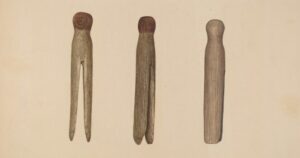
Long before technology sent single socks into a spinning purgatory, people were more resourceful, creating tools to effectively complete the most daunting of household chores.
One of those tools is this wooden peg, which over the years evolved into a two-piece pin that secured items to a line. This was a significant improvement from the earlier model that fed socks and other garments to the wind, “a serious evil to washerwomen.”
Keep reading to learn more about this wooden tool!
Recently, an online user found little wooden dowels with two legs and went to social media looking for help in identifying the objects.
The Facebook post attracted a generation of nostalgic boomers, offering the answer: “Old school clothespins. [We] used them for hanging clean wet clothes outside on the [clothes] line to dry in the sun [and] fresh air!”
A wooden clothespin, also known simply as a clothes peg, is a traditional household tool used for hanging wet laundry on a clothesline to dry. Today, the pins typically consist of two wooden pieces hinged together at one end, with a spring mechanism that provides the necessary tension to grip onto the clothing.
Ancient times
The history of wooden clothespins can be traced back to ancient times when people used various methods to secure their laundry while drying.
The earliest carved clothespins date back to ancient times and were quite different from the wooden clothespins we are familiar with today. These early clothespins were typically handcrafted from natural materials such as wood, bone, or even stone, and oftentimes featured ornate patterns or motifs.
The modern wooden clothespin, as we know it today, emerged in the 19th century as a response to the growing need for a convenient and effective tool to hang laundry.
The earliest versions of the clothespins we know today, were handcrafted from solid wood, often maple or birch, and featured a simple design consisting of two pieces of wood hinged together with a small spring or metal wire.
‘Evil to washerwomen’ and men
The modern design we know today, dates back an 1853 patent of a clothespin by Vermont’s David M. Smith.
According to his patent, dated October 25, 1853, the updated clothespins “are hinged together” by a wire “so that the two longer legs may be moved toward each other and at the same time move the shorter ones apart.”
The two wooden pieces are shaped in such a way that they form a clamp when squeezed together. This allows the clothespin to securely hold onto garments without causing damage. The spring mechanism ensures that the clothespin remains closed when in use, providing a reliable grip on the laundry even in windy conditions.
Smith details in the patent: “Another advantage and a very important one too, [what] my improved clothes pin possesses over the common pin is that it cannot be detached from the clothes by the wind as is the case with the common pin and which is a serious evil to washerwomen.”
Evolving pins
As industrialization progressed in the 19th and early 20th centuries, the manufacturing process for wooden clothespins became more mechanized. Wooden clothespin factories emerged, producing large quantities of standardized clothespins at a faster rate and lower cost. This made wooden clothespins more accessible to a broader range of households, contributing to their widespread use as a laundry tool.
Throughout the 20th century, wooden clothespins remained a staple in households worldwide, despite the introduction of alternative materials such as plastic. Their simplicity, durability, and affordability made them a preferred choice for hanging laundry, particularly for those without access to modern drying technologies.
Today, wooden clothespins continue to be produced and used in households around the world, either for crafts or clothes drying, and are cherished for their nostalgic appeal and eco-friendly properties.
While plastic clothespins have become more prevalent in some regions due to their lower cost and mass production, wooden clothespins remain a symbol of traditional laundry practices and sustainable living.
What’s worse, losing socks to the wind or in a dryer? Please let us know what you think of this story and then share it with your friends so we can hear what others have to say!