In a sharp escalation of regional tensions, Iran has launched missile and drone attacks across parts of the Middle East following coordinated strikes by the United States and Israel on targets inside Iranian territory. The exchange marks one of the most serious confrontations in years among the three powers.
Strikes Inside Iran
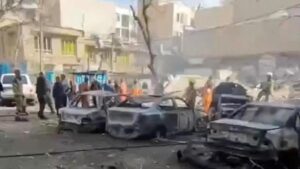
In the early hours of February 28, 2026, U.S. and Israeli forces reportedly carried out a joint operation targeting locations described as strategic military and leadership-linked sites across several Iranian cities, including Tehran, Isfahan, Tabriz, and Qom. Explosions were reported in multiple areas, and satellite imagery circulating through international media appears to show structural damage in parts of central Tehran.
Iranian authorities have stated that civilian casualties occurred in some locations, including a strike in Minab that reportedly hit a girls’ school. Independent verification of casualty figures remains ongoing. Emergency services were seen responding across affected areas as smoke rose over sections of the capital.
Regional Retaliation
Within hours, Iran’s Islamic Revolutionary Guard Corps announced retaliatory action. Missiles and drones were launched toward U.S. military bases, Israeli positions, and installations in several Gulf states. Regional governments confirmed attempts to intercept incoming projectiles, with air defense systems activated in multiple countries.
While many missiles were reportedly intercepted, at least one fatality has been linked to falling debris in the United Arab Emirates. Authorities in Qatar, Bahrain, Kuwait, and other host nations acknowledged that their territories were targeted or affected, highlighting how quickly the confrontation expanded beyond its initial focal points.
International Reaction
Global responses have been immediate. Russia condemned the joint strikes as unlawful and called for urgent United Nations Security Council consultations. European governments urged restraint and emphasized the protection of civilians under international humanitarian law. Emergency diplomatic discussions are underway in several capitals.
Markets and transportation networks have also felt the impact. Airspace closures in parts of Iran, Iraq, and the Gulf region disrupted commercial flights. Security alerts have been heightened globally amid concern that escalation could trigger further instability.
Tehran’s Position
Iranian officials characterized the U.S.-Israeli operation as a violation of international law and warned of continued response if attacks persist. Government statements framed the retaliation as defensive, while also signaling readiness for further measures. State media repeated warnings that regional American and Israeli assets could face additional targeting.
Reports from Tehran suggest some residents have sought temporary relocation amid fears of additional strikes. Fuel queues and precautionary measures reflect public anxiety in uncertain conditions.
A Fragile Moment
Analysts describe the current cycle of strike and counterstrike as a significant escalation in a long-standing confrontation shaped by disputes over nuclear policy, regional alliances, and proxy conflicts. While previous flare-ups have been contained, the geographic breadth of the latest exchange raises concern about miscalculation and unintended consequences.
In moments like this, the human cost risks being overshadowed by strategy and rhetoric. Civilians across several countries now find themselves living under air-raid sirens and uncertainty. Military objectives may be calculated; the disruption to ordinary life rarely is.
Officials across the region and beyond are urging de-escalation. Whether the coming days bring restraint or further retaliation will depend on decisions made under intense pressure. History shows that once cycles of response harden, stepping back becomes harder — but not impossible.
For now, the situation remains fluid. Clarity will come in stages. What remains constant is the need for measured leadership, protection of civilian life, and diplomatic channels strong enough to prevent broader conflict.