Twenty years after my mother disappeared from my life, she reappeared on my doorstep with nothing but a grocery bag
and an unspoken demand for entry. What she said next would shatter everything I thought I knew about forgiveness.
My childhood feels like watching someone else’s life through a dirty window — blurry, distant, but with certain sharp fragments that pierce straight through.
I have no memory of my father. He vanished before I could form words. The only proof of him is his name on my birth certificate. That’s it. A blank where half my story should be.
“Your daddy went away,” my mother would say when I asked. “Sometimes people just go away, Stacey.”
I didn’t know then how much those words would echo later.
My mother, Melissa, was present — physically. But never in the way a mother should be. There were no bedtime stories, no shared laughter, no gentle hands brushing my hair. Just long silences, exhaustion, and anger that filled the house like stale air.
We lived in a cramped, dim apartment on the wrong side of town. I still remember the peeling wallpaper and windows so dirty they blurred the outside world. I spent hours staring out of those windows, wondering what it was like on the other side.
Mom worked long hours at a grocery store, coming home bitter and drained.
“I can’t do this anymore,” she’d mutter at night, stirring instant noodles. “I just can’t.”
I thought she meant her job. The broken dishwasher. Life. I didn’t know she meant me.
I was nine the day everything collapsed. I burst through the door, excited to share my perfect score on a spelling test. Instead, I found her sitting at the table with a pile of papers and swollen red eyes.
“Stacey,” she said flatly, “I can’t take care of you anymore.”
I froze. “What do you mean?”
“I tried, but I can’t do it. Someone from social services will come tomorrow. They’ll take good care of you. This is just temporary.”
The next morning, a woman named Mrs. Patterson arrived. She knelt and smiled warmly, but I clung to my mother, who stood stiffly as she packed my clothes into a garbage bag.
“Be good, Stacey,” she said, not meeting my eyes. “I’ll see you soon.”
I believed her. God help me, I believed her.
But ‘soon’ never came.
The children’s home was cold and echoey, filled with other kids waiting for parents who never returned. I told everyone my mom was coming back. Teachers. Social workers. Other kids. I clung to the story like armor.
On my mom’s birthday two years later, I scraped together my allowance to buy her a card. I mailed it to the last address I had. Two weeks later, it came back stamped Return to Sender.
That was the day I stopped asking questions.
By thirteen, I learned that hope was dangerous. You build armor instead. Keep quiet. Make yourself small. Unnoticeable.
At 27, I had my own daughter. Emma arrived screaming and perfect, with wide eyes that trusted me instantly.
Instead, I stepped aside.
At first, she was polite. Helped with dishes. Smiled at Emma. But soon, the familiar bitterness seeped through.
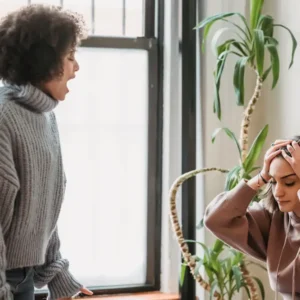
“If you weren’t so difficult back then, maybe things would’ve been different,” she said casually one morning.
“I was nine,” I replied, my voice shaking.
Her response? Silence. Dismissive silence.
The breaking point came when I overheard her whispering to Emma:
“Your mom was very difficult when she was little. Sometimes you have to step back from people who hurt you. Even family.”
I packed her belongings into a garbage bag — just like she had packed mine all those years ago.
“You need to leave,” I said, setting the bag by the door.
“You’re really throwing your own mother out?”
“You left me a long time ago.”
“Family is all you have,” she hissed.
“No,” I said, steady now. “Love is all you have. And you gave up the right to mine.”
She left. And I finally breathed again.
A month later, I sent her a card for her birthday. It was blank, except for a simple message inside:
“Sometimes you have to step back from people who hurt you.”
I don’t know if she understood. I don’t care.
Because I finally understood what she never did:
Being a parent isn’t about what you expect from your child. It’s about what you give to them. And I will give Emma everything my mother couldn’t give me.