More than six decades after President John F. Kennedy was tragically assassinated in Dallas, the federal government took a significant step forward on Tuesday by releasing what could be the final batch of documents related to the assassination that stunned the nation and sparked a multitude of conspiracy theories.
The National Archives and Records Administration began posting the eagerly awaited files just before 7 p.m. — a day after President Donald Trump announced that 80,000 pages connected to the fatal shooting on November 22, 1963, would soon be made available to the public.
“In accordance with President Donald Trump’s directive of March 17, 2025, all records that were previously classified as confidential and are part of the President John F. Kennedy Assassination Records Collection have now been released,” the administration’s statement declared.
Within minutes, thousands of documents that had remained hidden for decades were made accessible online.
It remained unclear whether the new batch of documents contained any groundbreaking revelations or evidence to challenge the conclusion reached by the Warren Commission in 1964 — that Lee Harvey Oswald, a lone gunman, fired the fatal shots from the Texas Schoolbook Depository.
“You’ve got a lot of reading ahead of you,” Trump remarked on Monday during a visit to the John F. Kennedy Center for the Performing Arts in Washington. “I don’t believe we’re going to redact anything.”
Trump remained somewhat tight-lipped about the contents of the files. Historians speculate that around 4,700 documents had yet to be released prior to this drop.
Jefferson Morley, a recognized expert on the JFK assassination and the CIA, noted on his “JFK Facts” blog before the documents were unveiled that the origins of the 80,000 pages of material were still unclear.
Justice Department lawyers had reportedly worked through the night to review hundreds of classified pages before their release, according to sources familiar with the situation.
It also remained uncertain whether this new release would finally quell the widespread public skepticism about the government’s official stance that Oswald acted alone.
“There are so many doubts,” noted presidential historian Michael Beschloss. “There are countless conflicting theories. It’s hard for me to believe there’s one single piece of evidence that could settle everyone’s opinion on what really happened. What most people do agree on, though, is that the assassination of John Kennedy changed history — and not for the better.”
Last year, while campaigning for president, Trump renewed his pledge to release the files, hoping to win the endorsement of JFK’s nephew, Robert F. Kennedy Jr.
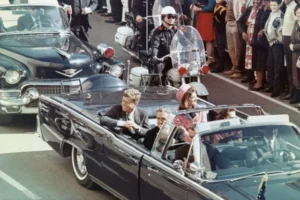
In August, just hours after securing Robert F. Kennedy Jr.’s endorsement, Donald Trump promised that, if elected, he would create a commission to investigate assassination attempts, in tribute to RFK Jr., who now serves as his Secretary of Health and Human Services.
Soon after beginning his second term, Trump signed an executive order directing the release of all records related to the assassination of President Kennedy, along with the 1968 killings of RFK Jr.’s father, Senator Robert F. Kennedy Sr., and Dr. Martin Luther King Jr. According to the President John F. Kennedy Assassination Records Collection Act of 1992, all documents related to Kennedy’s assassination were supposed to have been released by 2017, during Trump’s first term.
Although Trump did release some documents on JFK’s assassination, he also allowed intelligence agencies more time to review the remaining files.
It wasn’t until December 2022 that President Joe Biden released over 13,000 additional records after the Mary Ferrell Foundation, the largest nonprofit archive of JFK assassination documents, took legal action to force the release of all remaining files.
However, Biden only made about 98% of the records available to the public, with the National Archives still holding onto some classified documents related to the assassination.
“This is long overdue,” said Jefferson Morley, vice president of the Mary Ferrell Foundation, at the time. “The government needs to finally follow the law and make this history available to the public.”
Among the remaining 4,700 documents were believed to be additional details about Lee Harvey Oswald’s trip to Mexico City before the assassination, including 44 files about CIA agent George Joannides and a covert Cuba-related operation he oversaw, which interacted with Oswald just months before Kennedy was killed.
In his explanation for withholding some documents, Biden referenced the records act, which allows continued postponement of disclosure when releasing information could jeopardize military defense, intelligence operations, law enforcement, or foreign relations. He argued that such concerns outweighed the public’s right to know.
Many prominent historians, however, found this rationale unconvincing.
“We’re 59 years past President Kennedy’s assassination, and there’s simply no reason to keep these records under wraps,” said U.S. District Judge John Tunheim, who led the Assassination Records Review Board from 1994 to 1998.