Astronomers have identified an extraordinary object that existed when the universe was only about 660 million years old.
The object, known as MoM-BH-1*, was observed with NASA’s James Webb Space Telescope. At first, it appeared to be an unusually bright red object in the distant universe. But when scientists studied its light in greater detail, they found something that could not easily be explained by an ordinary star.
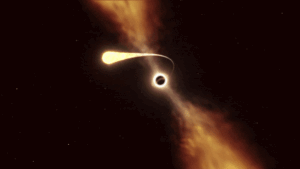
Researchers believe the object contains a rapidly growing black hole surrounded by an enormous, extremely dense cloud of hydrogen gas. The gas may make the system appear more like a gigantic star, while the black hole at its center provides the energy.
The object is estimated to be roughly comparable in scale to our solar system, while its central black hole may have a mass around 100,000 times that of the Sun, according to estimates highlighted by the research team.
What makes the discovery especially interesting is its incredible brightness. Scientists estimate that the object produces an amount of energy equivalent to roughly 100 billion Suns.
The discovery could also help solve one of the biggest mysteries found by the James Webb Space Telescope: the strange population of distant objects known as “little red dots.” Astronomers have been trying to understand what powers these mysterious objects since Webb began observing them.
Scientists emphasize that much more research is needed to understand exactly what MoM-BH*-1 is. But if the interpretation is correct, it could give astronomers a rare glimpse into how some of the universe’s earliest massive black holes formed and grew.
And perhaps most astonishing of all: the light Webb detected began its journey toward Earth more than 13 billion years ago.