Scientists Tracked an Eagle for 20 Years—What They Learned Changed How We See Nature



For years, scientists monitored the movements of an eagle equipped with a GPS tracker. The project was expected to provide valuable information about migration habits and seasonal travel routes. Instead, it raised more questions than answers.
Rather than following predictable paths between breeding and feeding grounds, the bird repeatedly traveled across deserts, mountains, forests, and coastlines in unusual directions. Sometimes it doubled back hundreds of miles. Other times it paused in locations that seemed to have no obvious ecological importance.
At first, researchers suspected errors in the tracking equipment. Yet year after year, the data remained consistent. The eagle’s movements appeared deliberate, but the reasons behind them were difficult to understand.
A Journey That Defied Expectations
Traditional migration studies often reveal patterns that are remarkably consistent. Birds usually follow routes shaped by weather conditions, food availability, breeding cycles, and geographical landmarks.
This eagle seemed different.
Maps generated from twenty years of tracking data showed intricate lines crossing multiple regions and ecosystems. The routes appeared chaotic when viewed from a distance, leading some researchers to wonder whether the bird was simply behaving unpredictably.
However, deeper analysis told a different story.
Scientists began comparing the eagle’s travel patterns with environmental records, including wind currents, seasonal climate shifts, prey populations, and landscape changes. Gradually, meaningful connections emerged.
Image: Mapping a Lifetime of Flight
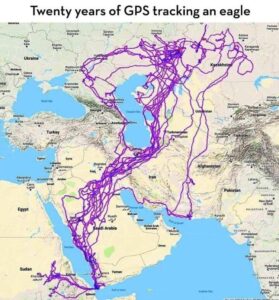


The bird was not wandering aimlessly. Instead, it appeared to be responding to subtle environmental cues that changed over time.
Strong seasonal winds helped explain certain detours. Variations in food sources accounted for unexpected stops. Even shifts in habitat conditions appeared to influence parts of the route.
What once looked random began to reveal a complex strategy for survival.
Nature’s Hidden Intelligence
Researchers discovered that the eagle’s behavior reflected an extraordinary ability to adapt.
Rather than relying on a fixed migration corridor, the bird adjusted its movements according to changing conditions. This flexibility may have allowed it to conserve energy, locate food more efficiently, and avoid environmental challenges.
The findings suggest that some wildlife species may possess a far greater capacity for dynamic decision-making than previously understood.
Instead of following a rigid blueprint, the eagle seemed to continuously interpret information from its surroundings and alter its course accordingly.
Why the Discovery Matters
The study offers important insights into conservation efforts.
As climate change, habitat loss, and environmental disruptions continue to reshape ecosystems, animals that can adapt their behavior may have a better chance of survival.
Understanding how wildlife responds to changing conditions helps scientists develop more effective conservation strategies and protect critical migration corridors.
Image: Lessons From a Master Navigator


The eagle’s remarkable journey serves as a reminder that nature often contains patterns that are not immediately visible. What appears chaotic at first glance may actually reflect a sophisticated response to a constantly changing world.
The Bigger Picture
After two decades of observation, scientists came away with more than migration data. They gained a deeper appreciation for the complexity of animal behavior and the intelligence embedded within natural systems.
The eagle’s story demonstrates that survival is not always about following the same path year after year. Sometimes, success comes from adapting, learning, and responding to the world as it changes.
In the end, the bird’s seemingly mysterious journey revealed a powerful truth: nature is often far more interconnected and adaptive than humans first assume.