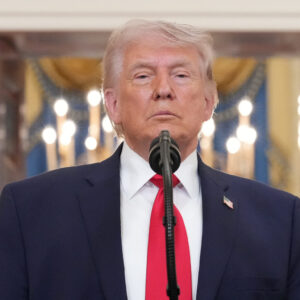
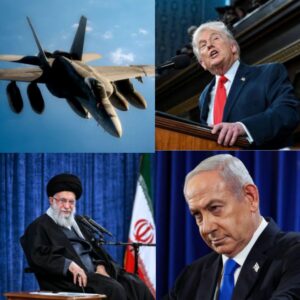
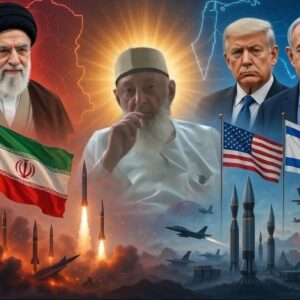
The promise was restraint. The reality, at least in appearance, is escalation. In the span of a little more than a year, Donald Trump’s public posture has moved from pledges of avoiding new conflicts to supporting strikes connected to rising tensions with Iran, while simultaneously advancing the release of long-anticipated government files tied to unidentified aerial phenomena. On the surface, these developments may seem unrelated—one rooted in geopolitics, the other in public curiosity—but their timing has invited a deeper, more uneasy question: how do overlapping crises shape what the public is able to see clearly?
Trump’s alignment with Israeli military actions against Iran, following a campaign narrative centered on restraint, has introduced a layer of uncertainty both domestically and internationally. Supporters frame it as pragmatic adaptation to evolving threats, while critics see a departure from earlier commitments. What remains less clear, at least to the public, is the degree to which the underlying intelligence justifying escalation has been fully communicated. In the absence of widely accessible, definitive evidence pointing to an immediate nuclear threshold, interpretation begins to fill the gaps—and interpretation, by its nature, is rarely neutral.
It is within these gaps that suspicion tends to grow. Not always because there is hidden design, but because incomplete information creates space where certainty cannot hold. Alongside geopolitical tensions, unresolved domestic controversies continue to linger in public consciousness, including the still-partially sealed records connected to Jeffrey Epstein. The existence of redactions and unanswered questions has sustained a low but persistent level of scrutiny, not necessarily anchored in verified conclusions, but in the perception that something remains undisclosed.
At the same time, renewed attention toward declassified UFO-related materials has shifted portions of public discourse into a different register—one driven less by immediate consequence and more by fascination, speculation, and the search for extraordinary explanations. For some observers, the convergence of these narratives—military tension, incomplete disclosures, and high-profile declassifications—feels less like coincidence and more like misalignment. For others, it reflects the normal, if messy, overlap of unrelated developments competing for attention in a crowded information environment.
The challenge, however, is not simply determining intent. It is recognizing how easily attention can be redirected when multiple high-intensity stories unfold at once. Public focus is not infinite; it moves, adapts, and often fragments. When it does, clarity can become more difficult to sustain, not because truth disappears, but because it becomes harder to follow consistently across shifting priorities.
This is where the deeper question emerges—not about any single decision, but about perception itself. When events of global significance unfold alongside unresolved domestic issues and attention-grabbing disclosures, the public is left navigating a layered landscape where urgency, curiosity, and suspicion coexist. In such an environment, the risk is not only misinformation, but premature conclusions—either assuming deliberate coordination where none exists, or dismissing legitimate concerns too quickly.
What remains essential, then, is a steady approach to understanding. Distinguishing between what is confirmed, what is suggested, and what is still unknown requires patience that runs against the speed of modern discourse. It requires resisting the pull of narratives that feel complete simply because they connect emotionally or intuitively, and instead holding space for complexity where easy answers are not yet available.
Because in the end, the most important question may not be which single event demands attention, but whether attention itself is being applied carefully enough. Not every overlap signals intention, but neither should every question be dismissed as coincidence. Between those two extremes lies a more demanding task: to observe without rushing to closure, and to recognize that clarity is often built slowly, especially when multiple stories unfold at once.