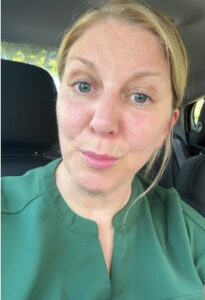
For most of us, death is something we try not to think about — until we’re forced to. But for hospice nurse Julie McFadden, it’s part of everyday life.
After years of walking people through their final moments, this California nurse has seen it all, and now she’s opening up about which diseases bring the most suffering at the end, and which allow for something far more peaceful.
Julie McFadden is a seasoned hospice nurse who has guided more than 100 patients through their final days. Her raw, unfiltered reflections on death have struck a nerve online, resonating deeply with those who’ve witnessed loved ones endure the heartbreaking toll of terminal illness.
The worst way to die
If there’s one disease McFadden doesn’t hesitate to call the worst, it’s ALS — also known as Lou Gehrig’s disease.“This is the cruelest death I’ve ever seen,” Julie told Problem Solved last year.
And it’s not hard to understand why. ALS slowly shuts down every voluntary muscle in the body. Over time, patients lose the ability to move, speak, swallow, and eventually, even breathe. But what makes it especially tragic is that the mind stays sharp. People are trapped in a failing body, fully aware of what’s happening.
“Watching someone you love fade like that, knowing they’re still in there? It’s devastating,” one commenter wrote, reflecting on her father’s battle with the disease.
By 2030, an estimated 36,300 people in the U.S. will be diagnosed with ALS. While it’s still considered a relatively rare disease, it progresses quickly—half of those diagnosed with motor neuron disease (MND) will die within 14 months of their diagnosis.
The condition is always fatal, and there’s currently no cure. However, the timeline varies widely — some people decline rapidly within months, while others may live for several years after being diagnosed.
TikToker Jessica Weiser also commented on the podcast, saying: ”I knew she would say ALS. Lost my dad to it, most cruel thing I’ve ever witnessed.”
”My brother in law just passed last year from ALS. Horrible disease,” commenter JZ shared.
Another listener also weighed in: ”My grandma has ALS. It’s the worst thing seeing her deteriorate. Wouldn’t wish it on anyone.”
Another brutal exit: Glioblastoma
The second disease McFadden points to is glioblastoma, an aggressive form of brain cancer that moves fast and hits hard.
“It takes everything — your memory, your motor skills, your personality,” McFadden says. “And it does it quickly.”
This cancer is known for its terrifying symptoms: seizures, memory loss, confusion, and unbearable headaches. Most patients die within a year and a half of diagnosis. Family members often say it feels like watching someone disappear in real time.
On average, people diagnosed with glioblastoma live between 12 and 18 months. Just 1 in 4 patients make it past the one-year mark, and fewer than 5 out of 100 survive longer than five years.
One woman shared on social media: “He was gone before he died. That’s what makes it so hard.”
Surprisingly peaceful
On the flip side, McFadden says that end-stage kidney failure can offer one of the most serene ways to go — especially when dialysis is stopped intentionally as part of end-of-life care.
“When patients stop dialysis, they usually just get sleepy. And then they don’t wake up,” she explains. “It’s peaceful. It’s painless. And it allows families time to say goodbye.”
For many, that chance to control the process — surrounded by love, without pain —is a gift. One person commented: “We played music, held his hand, and he just slipped away. It was beautiful, in a way.”
User Miharty agreed: ‘My dad passed of late stage kidney disease. He stopped dialysis when he was ready to go. We all got to say goodbye on his terms. He was done.’
Why this matters
McFadden’s stories aren’t just about medical facts. They’re about dignity, comfort, and humanity in the final chapter of life.
As Americans continue to wrestle with how we treat the elderly and terminally ill, conversations like these are becoming more important than ever. Hospice workers like McFadden are often the only ones willing to speak plainly about what dying really looks like — and how we can make it better.
In the End…
Death is unavoidable, but not all deaths are the same. From the silent torment of ALS to the chaotic unraveling of glioblastoma, and the rare peace of kidney failure, Julie McFadden’s message is clear: how we die matters.
And with the right support, even the hardest goodbyes can be filled with love.