If you thought your New York apartment building was packed, think again.
In Hangzhou, China, the Regent International Apartment Complex takes “city living” to a whole new level — reportedly home to a staggering 20,000 residents.
Dubbed a “dystopian apartment block” by some, this S-shaped behemoth isn’t just about high population density — it’s a vertical city designed so self-contained that residents could, theoretically, never leave. There are 5,000 apartments, gyms, swimming pools, supermarkets, restaurants, salons, internet cafes, and even schools and hospitals, all under one roof.
The complex started in 2013 as a six-star hotel concept designed by Alicia Loo, chief designer of Singapore’s Sands Hotel.
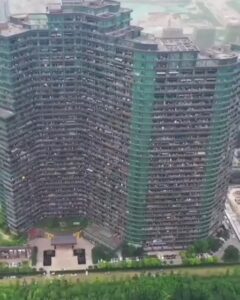
But economic realities transformed it into a residential giant, now popular with students, graduates, and young professionals. Studios without windows rent for around 1,500 RMB ($210) a month, while larger apartments with balconies go for 4,000 RMB ($570) — a fraction of New York’s $4,000+ monthly rent.
Standing 675 feet tall, its striking design and endless amenities draw curious tourists from all over.
Life inside the giant
Walking through Regent International is like wandering through a mini city. Sky bridges and long hallways connect multiple blocks, allowing residents to access nearly everything they need without stepping outside.
Apartments vary from compact studios to multi-bedroom units, all designed with modern finishes, open-plan layouts, and huge windows offering panoramic city views.
Common spaces are plentiful: swimming pools, gyms, restaurants, and food courts are scattered throughout, making it convenient to socialize or relax without leaving the building. Lower floors host supermarkets, retail shops, and more — basically, everything your average town provides.
The complex also features smart technology and sustainable infrastructure, including solar panels, rainwater recycling, and advanced HVAC systems. Security is top-notch with biometric access controls and CCTV coverage, giving residents peace of mind while navigating the enormous space.
Drone footage from TikTok’s @fatheristheone shows just how massive the building really is.
@fatheristheone The Regent International apartment in Hangzhou, China is famous for having a lot of inhabitants comparable to a small town, around 20,000 #unreal #😎 #followme #love #free #forever #friends #earth #biggest#apartments#hangzhou #china ♬ original sound – father is the one
A vertical society
But while convenient, living in a building this large raises some big questions.
A self-sufficient vertical city can foster community within walls but may also create social isolation from the wider city. Residents might know their neighbors well but rarely engage with the outside world. Social stratification is evident, too, with better apartments and amenities located on higher floors.
Critics argue that the design prioritizes efficiency over aesthetics, with repetitive geometric patterns and a stark, utilitarian feel.
Noise, lack of privacy, and the psychological impact of living in such a dense environment are all potential challenges. Yet for many, the building is a modern marvel, combining convenience, affordability, and sheer scale.
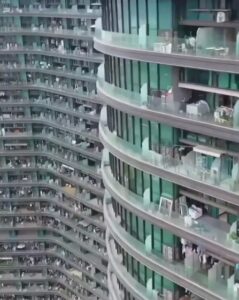
Not long ago, YouTuber NAEEM EXPLORER went inside the massive ‘dystopian’ Regent International and showed why residents rarely need to step outside, highlighting spacious apartments with stunning views.
Grab a spot on a balcony, and you could enjoy your morning coffee overlooking the serene Qianjiang skyline, surrounded by the city’s other towering glass buildings.
Of course, some people worry about the risks of power outages or natural disasters affecting such a colossal building. Others, however, can’t help but dream of life here. One commenter argued, “Humans aren’t meant to be separated from nature on such a scale,” while another wrote, “This actually looks really fun,” adding, “like how you have everything you need on a cruise ship.”
Regent International offers a glimpse into the future of urban living in hyper-dense cities. It’s an experiment in creating self-contained, sustainable communities, showing both the benefits and pitfalls of vertical life.
Architects and urban planners may take cues from its design — but balancing convenience with social and psychological well-being will be key.