At one point, superstitious people believed the $2 bill was “unlucky” and came with a curse.
But the deuce will not jinx its handler, instead it may bring a lot of luck along with a few thousand dollars.
Keep reading to learn how to determine the value of your $2 bill!
Long considered the unloved stepsibling of the $1 bill, the $2 note has often been scoffed at by many Americans. Some even think $2 bills are rare, not printed anymore or have gone out of circulation.
But in 2023, the Federal Reserve reports there were 1.6 billion crisp $2 bills in circulation, a tiny amount compared to 14.5 billion $1 bills or 11.2 billion $20 bills.
Widely unappreciated, the banknote has gained a bit of momentum over the past 20 years, where in 2004, there were only 0.07 billion in circulation, a small fraction of the $24.2 billion currency circulated that year.
The Bureau of Engraving and Printing (BEP) explains that “for most of their history, $2 notes have been unpopular, being viewed as unlucky or simply awkward to use in cash exchanges.”
Notes were often “returned to the Treasury with corners torn off, making them mutilated currency and unfit for reissue,” the BEP writes of superstitious people who ripped the corners, hoping to reverse the curse.
Meanwhile, the New York Times wrote in a 1925 article, “He who sits in a game of chance with a two-dollar bill in his pocket is thought to be saddled with a jinx. They have been avoided as ill-starred.”
The banknote is even the star of a documentary, The Two Dollar Bill, a 2015 film that explores “all aspects of the deuce, from its history to the many superstitions surrounding it.”
Despite their lack of popularity, the $2 bill is still underestimated and is at least worth two dollars.
Some $2 notes, however, may be valued at thousands.
History
In 1862, the first official $2 banknote was printed with the face of Alexander Hamilton, the Founding Father of the U.S. Secretary of the Treasury, on the front.
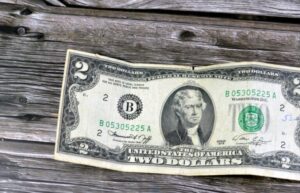
It was in 1869 that the bill was redesigned to feature a portrait of Thomas Jefferson, the third president of the United States, a key image that remains unchanged to this day.
#HappyBirthday, Mr. President! Thomas Jefferson was born April 13, 1743, in Shadwell, #Virginia and first appeared on the $2 bill in 1869. #FoundingFather pic.twitter.com/XeoOxrbqk9
— BEP (@BEPgov) April 13, 2021
On the flipside was the picture of Monticello, Thomas Jefferson’s estate in Virginia, but the back was changed to a vignette of the signing of the Declaration of Independence, the famous document authored by Jefferson.
Fetching a fortune
While the $2 bill is synonymous with Jefferson’s portrait, the note has seen several changes on the back, along with some on the front, including placement and size of the photo and the addition of colors.
And some of these bills may be worth far more than what is suggests.
To find the value of your $2 bill, look at the year and seal color. Crisp, uncirculated bills with red, brown and blue seals from 1862 through 1896 can fetch about $5,000 at U.S. Currency Auctions. And if your note is a little crumbled and used, circulated bills from the same time can be worth up to $1,100.
There are also paper notes with red or blue seals from 1917 to 1928 that are worth $50 to $1000, depending on its condition.
Went to withdraw a bunch of $2 bills for WPAFW, and one of them was almost 100 years old pic.twitter.com/9i1bL4BXaY
— Sketchy Mouse (@SketchyMouse) September 27, 2024
The auction site reports that collectors offer these rates depending on factors such as printing method and location.
Also, some notes come with “fancy serial numbers,” so if you’re lucky to find one of these very rare notes, your two dollars can be worth up to $6,000.
Do you have a rare $2 bill? Please let us know what you think of this story and make sure you share it with your friends!